Yes. A horsebox must have the correct MOT or annual test before it can legally be used on the road.
The type of test it needs depends mainly on its Maximum Authorised Mass (MAM):
- A horsebox with a MAM of 3,500kg or less will normally need a standard MOT.
- A horsebox with a MAM of more than 3,500kg will normally need an HGV annual test.
- Horseboxes over 3,500kg that require an HGV annual test must also normally have a ministry plate and plating certificate.
There is an important exception for some zero-emission goods vehicles between 3,501kg and 4,250kg, which from 1 June 2026 are tested as Class 7 vehicles rather than through the HGV annual-test system.
An MOT and a ministry plate are not the same thing. The MOT or annual test checks whether the horsebox meets the required roadworthiness standards at the time of the test. The ministry plate records important approved information about a heavier vehicle, including its legal weight limits.
Horsebox MOT and plating rules at a glance
| Horsebox | Test normally required | Ministry plate? |
|---|---|---|
| Up to 3,500kg MAM | Standard MOT | No |
| Over 3,500kg MAM | HGV annual test | Normally yes |
| Qualifying zero-emission goods vehicle, 3,501–4,250kg DGW | Class 7 MOT | No |
The weight used for these rules is the vehicle's official maximum or design gross weight, rather than simply what it happens to weigh when empty.
What does Maximum Authorised Mass (MAM) mean?
Maximum Authorised Mass, usually shortened to MAM, is the maximum the vehicle is legally allowed to weigh when fully loaded.
This includes the weight of the horsebox plus everything you add, such as:
- horses;
- driver and passengers;
- tack and equipment;
- fuel and water;
- feed and bedding; and
- anything else being carried.
You may also see terms such as gross vehicle weight (GVW), design gross weight (DGW) or plated weight, depending on the vehicle and context.
For example, an empty horsebox might currently weigh 3,200kg. If its official maximum weight is 7,500kg, it is still treated as a vehicle over 3,500kg for testing purposes.
If you're unsure how MAM differs from payload or how much your horsebox can actually carry, our guide to horsebox payload and weight explains the figures in more detail.
What MOT does a 3.5-tonne horsebox need?
A horsebox with a MAM of no more than 3,500kg will normally use the standard MOT testing system.
Most light vehicles need their first MOT when they reach three years old and then another MOT every year.
The exact MOT class depends on how the vehicle is classified and its design gross weight. For example, goods vehicles over 3,000kg and up to 3,500kg are normally Class 7, while other vehicle classifications can be tested differently.
The MOT can cover areas including:
- brakes;
- steering;
- suspension;
- tyres and wheels;
- lights;
- seat belts;
- windscreen and wipers;
- exhaust and emissions; and
- vehicle structure.
Not every MOT centre can accommodate every horsebox. When booking, give the test centre your vehicle's registration details, dimensions and weight so it can confirm that it is able to test it.
What test does a horsebox over 3.5 tonnes need?
A horsebox with a gross weight of more than 3,500kg will normally need an HGV annual test, sometimes informally referred to as an HGV MOT.
GOV.UK specifically lists horseboxes over 3,500kg among the vehicles that require the HGV annual test.
The first test is normally required 12 months after the vehicle was first registered, with another test required each year after that. GOV.UK
Tests are carried out at authorised testing facilities (ATFs).
The annual test examines areas including:
- braking performance;
- steering;
- suspension;
- tyres and wheels;
- lights and reflectors;
- chassis and body condition;
- exhaust emissions;
- fuel systems; and
- driver visibility.
You can have the horsebox inspected by a qualified mechanic before its test to identify defects that may need attention.
Do I need to load my horsebox for its HGV annual test?
You may be asked to present a horsebox with suitable weight in it so its braking performance can be tested properly.
Current GOV.UK guidance advises loading a horsebox with suitable heavy items such as bags of feed or straw bales for the test.
Check with the testing facility beforehand about how it wants the vehicle presented.
You should not transport horses to the annual test simply to provide test weight.
What is a ministry plate?
A ministry plate is a document displaying approved information about a heavy vehicle.
Horseboxes over 3,500kg that require an HGV annual test must normally have:
- a ministry plate, sometimes called an HGV plate; and
- a plating certificate.
These documents contain important vehicle information and approved weight limits.
 An example of a plating certificate (left) and a 'ministry' plate (right).
The ministry plate should be displayed inside the cab where it is easy to see and read. The separate plating certificate forms part of the vehicle's documentation.
Information can include:
- registration number;
- Vehicle Identification Number (VIN);
- manufacturer and model;
- gross vehicle weight;
- maximum train weight;
- individual axle-weight limits; and
- other approved vehicle details.
These figures are particularly important because staying below the horsebox's overall weight limit is not enough - you also need to remain within its permitted axle weights.
Is plating another type of MOT?
No.
This is probably the most important distinction in this article.
A ministry plate records approved information about the vehicle, including its legal weight limits.
The annual test assesses whether the vehicle meets the required roadworthiness standards at the time it is tested.
A horsebox over 3,500kg will normally require both, but you do not generally get an entirely new ministry plate every time the horsebox passes its annual test.
Do I need to arrange horsebox plating every year?
No. Plating isn't normally a separate annual process.
Once the appropriate plate and plating certificate have been issued, they normally remain with the vehicle.
However, updated documents may be required if relevant vehicle details change - for example, following alterations that affect its approved weights or specifications.
This could become particularly relevant if a horsebox is uprated or downplated.
The plate and paperwork should always reflect the vehicle's current approved details.
Where can I find the ministry plate?
The ministry plate should be securely displayed inside the cab in a position where it can be easily seen and read.
Don't confuse it with:
- the manufacturer's original vehicle plate;
- VIN plate;
- conversion company's weight sticker; or
- a weighbridge certificate.
A horsebox can have several plates or labels containing weight information.
If you're unsure which figures apply, check the vehicle documentation or seek advice from DVSA or an appropriate vehicle specialist rather than guessing.
What if the ministry plate or plating certificate is missing?
If the plate or plating certificate is missing, damaged or unreadable, you can obtain replacements.
DVSA introduced an online service in 2026 that allows HGV owners to view and download their plating certificate and ministry plate, as well as current and previous MOT certificates. The service is free.
When buying a horsebox that should have these documents, check that:
- the ministry plate is present;
- registration and VIN details match;
- the weight limits are clear;
- the plating certificate is available; and
- the details correspond with the vehicle you're buying.
Don't simply rely on a weight quoted in an advert.
What about electric horseboxes over 3.5 tonnes?
There is now an important exception to the general 3,500kg dividing line.
From 1 June 2026, zero-emission goods vehicles with a design gross weight of more than 3,500kg and up to 4,250kg became Class 7 vehicles for MOT purposes.
Their first Class 7 MOT is normally required after three years, rather than after one year under the HGV annual-test system. They also do not require HGV ministry plates and plating certificates.
This exception applies to qualifying zero-emission goods vehicles. It does not include hybrids simply because they use some electric propulsion.
Because vehicle classification matters, check the official details for an electric horsebox rather than assuming that every vehicle above 3,500kg follows the same testing rules.
Is an MOT the same as a service?
No.
An MOT or HGV annual test is not a replacement for regular maintenance.
The test checks whether the vehicle meets the required standards at the time it is tested. It does not guarantee that the horsebox will remain safe until its next test.
A service helps maintain the vehicle and can identify worn or deteriorating components before they result in a breakdown or safety problem.
GOV.UK recommends having horseboxes regularly checked and serviced by a qualified mechanic in addition to carrying out regular safety checks.
How often should a horsebox be serviced?
There isn't one servicing interval that's appropriate for every privately owned horsebox.
How often yours needs attention can depend on:
- manufacturer recommendations;
- vehicle age;
- mileage;
- frequency of use;
- how long it spends standing;
- types of journey;
- typical load; and
- previous maintenance history.
Low mileage doesn't necessarily mean a horsebox needs less attention.
Long periods standing can contribute to problems with tyres, brakes, batteries and other components.
Ask a mechanic familiar with horseboxes or commercial vehicles to recommend an appropriate maintenance schedule for your particular vehicle.
Does the horse area need checking too?
Yes.
Passing an MOT or annual test does not mean you should assume that every part of the horse area is safe.
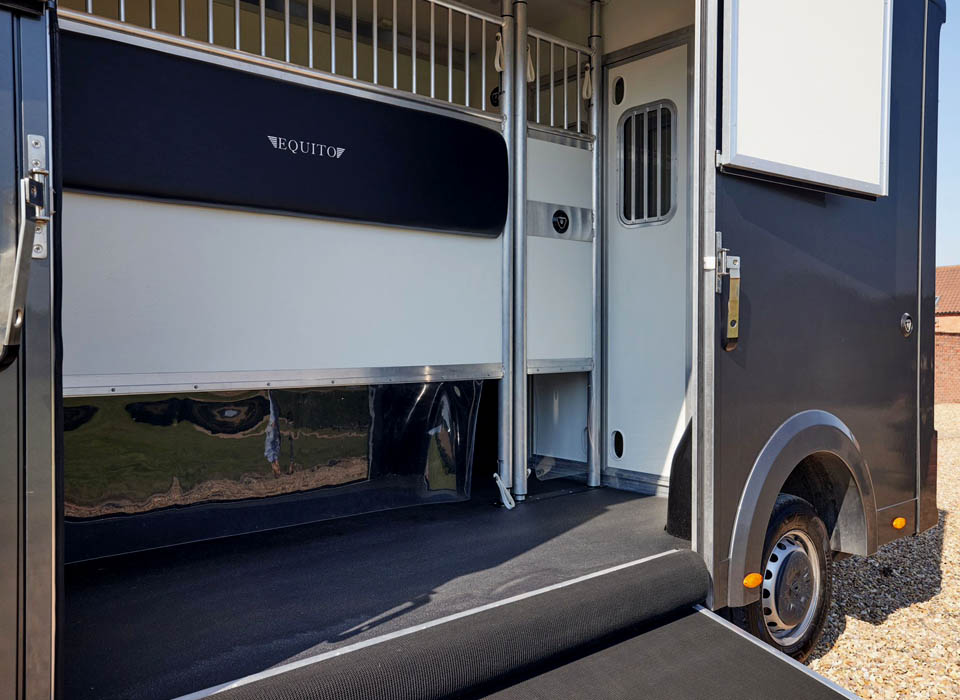
Regularly inspect:
- floors;
- underneath rubber matting or plates;
- internal walls;
- partitions;
- breast and breeching bars;
- fixings and catches;
- tie rings;
- doors;
- ramps;
- ramp mechanisms;
- ventilation; and
- lighting.
The floor deserves particular attention because damage or deterioration can be hidden underneath matting or plates.
Official horsebox guidance specifically advises owners to inspect the floor and underneath matting or plates, as well as checking the horse area for anything that could cause injury.
What should I check before travelling?
You should carry out a basic walkaround check before using your horsebox.
GOV.UK recommends:
- HGV daily walkaround checks for horseboxes over 3,500kg; and
- van daily walkaround checks for horseboxes of 3,500kg or less.
Checks can include:
- tyre condition and pressure;
- wheels;
- lights and indicators;
- mirrors and windows;
- wipers and washers;
- brakes;
- steering;
- leaks;
- number plates;
- bodywork and doors;
- ramp security;
- partitions and bars; and
- loose or damaged items inside the horse area.
Our horsebox safety-check guide gives you a practical checklist to work through before every journey.
A valid MOT does not make it acceptable to drive a horsebox with a safety defect that has developed since the test.
What if the horsebox is used commercially?
Commercial horsebox operators may need a more formal maintenance system, particularly where a goods vehicle operator's licence is required.
This can include:
- recorded driver walkaround checks;
- defect reporting and rectification;
- planned safety inspections;
- brake-performance assessments;
- maintenance records;
- evidence of repairs; and
- the annual HGV test.
Safety inspections are separate from routine servicing and the annual test.
DVSA's operator guidance says inspection intervals need to be determined according to factors such as the vehicle's age, condition, mileage and type of operation rather than applying one arbitrary interval to every vehicle.
If you're operating a horsebox commercially, our guide to becoming a professional horse transporter explains the wider requirements that may apply.
Does a privately used horsebox need six-week inspections?
Not automatically.
This is an important point to retain from the original article.
The frequently mentioned six-week inspection is associated primarily with formal commercial vehicle maintenance systems. It does not mean every privately owned horsebox has a legal requirement to visit a garage every six weeks.
Private owners are still responsible for keeping their vehicles roadworthy.

How frequently professional inspections are sensible will depend on factors such as the horsebox's:
- age;
- condition;
- mileage;
- frequency of use; and
- maintenance history.
An older horsebox or one that has spent a long period standing may need closer attention even if it covers relatively few miles.
What happens if the horsebox fails its MOT or annual test?
If your horsebox fails, the test result will identify the defects that need attention.
It may need repairs before being presented for a retest.
Whether you're legally able to drive it away depends on factors including:
- whether its existing certificate remains valid;
- the type and severity of the defects; and
- whether a dangerous defect has been recorded.
A vehicle with a dangerous defect must not be driven until it has been repaired.
A professional pre-test inspection can help identify problems before the vehicle is presented for its MOT or annual test.
Can I check a horsebox's MOT history?
Yes.
You can check a vehicle's MOT history online using its registration number.
Depending on the vehicle and record, this can help you see information such as:
- current test status;
- previous passes and failures;
- recorded defects;
- advisory items; and
- mileage recorded at previous tests.
Previous failures and advisories can be useful when assessing a horsebox, but they should not replace an independent pre-purchase inspection.
This is particularly important because an MOT history cannot tell you everything about the condition and safety of the horse area.
What should I check when buying a horsebox?
Before buying a horsebox, ask to see:
- its current MOT or annual-test record;
- ministry plate, where required;
- plating certificate, where required;
- recent weighbridge certificate;
- service history;
- relevant safety-inspection records;
- evidence of previous repairs;
- evidence of floor inspections; and
- registration and VIN details.
Check that the vehicle's approved weight is suitable for both the load you need to carry and the driving licence you hold.
It is also sensible to arrange an independent inspection by someone who understands horseboxes. A mechanical inspection alone may not identify every problem with the floor, ramp, partitions, horse area or conversion.
Does my horsebox need an MOT or plating?
As a simple guide:
- Up to 3,500kg: normally a standard MOT.
- Over 3,500kg: normally an HGV annual test.
- Over 3,500kg and subject to HGV annual testing: normally requires a ministry plate and plating certificate.
- Qualifying zero-emission goods vehicles from 3,501kg to 4,250kg: Class 7 MOT under the rules introduced on 1 June 2026.
- Plating and annual testing are not the same thing.
- An MOT or annual test does not replace servicing and regular safety checks.
If you're unsure which weight of horsebox you can legally drive, our guide to what horsebox you can drive on your licence explains the Category B, C1 and Category C rules.
Find horsebox HGV training near you
If the horsebox you choose requires C1 or Category C entitlement and you don't already have it, our step-by-step guide to getting a horsebox licence explains how to gain the appropriate licence.
You can then use Horsemart's HGV training-centre directory to find a suitable training provider near you.
This guide covers vehicle-testing rules in England, Scotland and Wales. Different arrangements apply in Northern Ireland. Vehicle classification and exemptions can vary, so check the official details for your particular vehicle.