Choosing the right size horsebox isn't simply about how many horses appear to fit inside.
You also need to consider:
- the weight and size of your horse or horses;
- passengers;
- tack and equipment;
- water, fuel, feed and bedding;
- the horsebox's legal weight limit;
- its actual available payload; and
- the driving licence you hold.
A horsebox advertised as a two-horse box may not necessarily have enough legal payload to carry two large horses once you add the driver, passengers, tack, water and everything else you need for the journey.
Understanding horsebox payload, Maximum Authorised Mass (MAM) and axle weights will help you choose a vehicle that's practical for your needs while staying within its legal weight limits.
Horsebox weights at a glance
| Term | What it means |
|---|---|
| Unladen weight | The weight of the vehicle without passengers, goods or fuel |
| Mass in running order | The weight of the empty vehicle ready for the road, including essential fluids, fuel and a driver |
| MAM or GVW | The maximum the horsebox is legally allowed to weigh when fully loaded |
| Payload | The weight available for horses, people, tack, water and everything else you add |
| Axle weight | The amount of weight carried by each axle |
The two most useful figures when choosing a horsebox are its MAM and its actual available payload.
What does Maximum Authorised Mass (MAM) mean?
Maximum Authorised Mass (MAM) is the maximum the horsebox is legally allowed to weigh when fully loaded.
You may also see it described as:
- Gross Vehicle Weight;
- GVW;
- permissible maximum weight; or
- plated weight.
The MAM is normally shown on a plate or sticker fitted to the vehicle.
The total loaded weight includes:
- the vehicle itself;
- horses;
- driver;
- passengers;
- tack;
- feed and bedding;
- water;
- equipment; and
- anything else you're carrying.
For example, a horsebox with a MAM of 3,500kg must not weigh more than 3,500kg when fully loaded.
This figure is also important for your driving licence. If you're unsure what weight of horsebox your current licence allows you to drive, our guide to what horsebox you can drive on your licence explains the Category B, C1 and Category C rules.
What is the unladen weight of a horsebox?
The unladen weight is the weight of the vehicle when it isn't carrying passengers, horses, equipment or other items.
Under the official definition, it includes the vehicle body and parts normally used with the vehicle, but it does not include fuel.
An advertised unladen weight doesn't necessarily tell you exactly how much the horsebox will weigh when you're ready to travel.
A horsebox may also have gained weight since it was originally built or converted through additions such as:
- new partitions;
- additional storage;
- a larger living area;
- an awning;
- extra batteries;
- a generator;
- replacement flooring; or
- other optional fittings.
Don't therefore rely solely on an old manufacturer's specification or an advertised empty weight when calculating how much you can carry.
What does mass in running order mean?
Mass in running order is the weight of the empty vehicle when it is ready to be used on the road.
For lorries, GOV.UK defines this as including the driver, body and parts normally used with the vehicle, essential fluids and a full tank of fuel.
This can provide a more useful starting point than unladen weight, but it still may not include all the equipment you routinely keep in your horsebox.
The best way to understand your actual available payload is therefore to weigh the horsebox itself in a condition that reflects how you normally use it.
What is horsebox payload?
Payload is the amount of additional weight you can put in the horsebox without exceeding its MAM.
A simple calculation is:
MAM − actual vehicle weight = available payload
For example:
Horsebox MAM: 3,500kg
Actual vehicle weight: 2,600kg
Available payload: 900kg
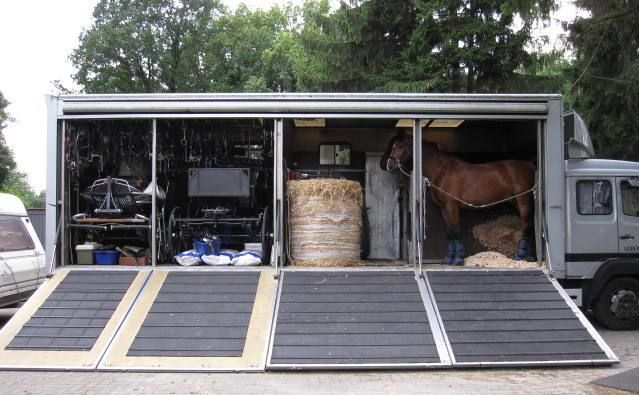
That 900kg needs to cover everything you add to the horsebox, including:
- your horse;
- driver;
- passengers;
- tack;
- water;
- feed;
- bedding; and
- equipment.
So a 900kg payload does not mean you can carry 900kg of horses.
That's one of the most important distinctions to understand when comparing horseboxes.
How much payload does a horsebox need?
There isn't one payload figure that's right for everyone.
The amount you need depends on what you actually carry.
For example, imagine a 3.5-tonne horsebox with an available payload of 900kg:
| Item | Example Weight |
|---|---|
| One horse | 550kg |
| Driver and passenger | 150kg |
| Tack and riding equipment | 70kg |
| Feed, hay and bedding | 30kg |
| 50 litres of water | Approx. 50kg |
| Other equipment | 30kg |
| Total added weight | 880kg |
That would leave just 20kg of available payload.
These are example figures only. Your horses, passengers and equipment may weigh considerably more or less.
But it illustrates why a 3.5-tonne horsebox with two horse spaces isn't automatically capable of legally carrying two horses.
How much does my horse weigh?
Horse weight varies considerably according to factors including:
- height;
- breed;
- build;
- age;
- fitness; and
- body condition.
Don't estimate weight based on height alone. A heavily built cob, for example, can weigh considerably more than a finer horse of similar height.
An equine weighbridge will give you the most useful actual measurement.
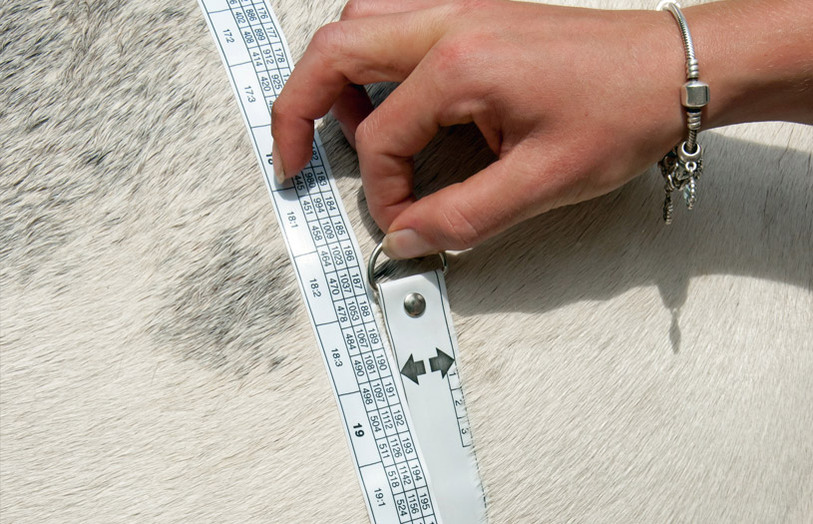
A weigh tape can provide an estimate where a weighbridge isn't available, although it won't be as precise.
Use your horse's current weight when calculating payload rather than relying on an old figure, particularly if its condition changes during the year.
Don't forget the weight of passengers
The driver and every passenger also contribute to the horsebox's loaded weight.
Remember to include:
- the driver;
- grooms;
- riders;
- friends and family;
- children; and
- any other animals travelling in the vehicle.
If each person weighs around 75kg, for example, adding two passengers uses another 150kg of payload.
This is easily overlooked when calculating whether you can legally carry two horses.
How much do tack and equipment add?
Individual pieces of equipment may not seem particularly heavy, but together they can use a surprising amount of payload.
Remember items such as:
- saddles and bridles;
- rugs;
- grooming kits;
- buckets and haynets;
- feed;
- water containers;
- wheelbarrows;
- show equipment;
- chairs and tables;
- spare partitions;
- tools and recovery equipment; and
- clothing and personal bags.

Permanent fittings matter too.
Cupboards, beds, fridges, cookers, tack lockers, generators and other fittings increase the vehicle's own weight, which means less payload remains available for horses and people.
Everything you carry counts towards the vehicle's total loaded weight, whether it's in the horse area, cab, tack locker or living accommodation.
How much does water weigh?
As a useful rule of thumb, one litre of water weighs approximately one kilogram.
So:
- 20 litres ≈ 20kg
- 50 litres ≈ 50kg
- 100 litres ≈ 100kg
A large water tank can therefore have a significant effect on payload when full.
That doesn't mean you should compromise the water your horses need for their welfare.
Instead, know the capacity of your tank and include the amount of water you actually intend to carry when calculating the vehicle's weight.
Is a 3.5-tonne horsebox big enough?
A 3.5-tonne horsebox can be a practical choice if:
- you usually transport one horse;
- your horse fits comfortably within the vehicle;
- your horse and normal load fit within the available payload;
- you travel relatively lightly;
- you want a more compact horsebox; and
- you want a vehicle that can normally be driven on a standard Category B car licence.
A normal Category B licence generally allows you to drive a petrol, diesel or hybrid vehicle with a MAM of up to 3,500kg.
But payload varies enormously between individual 3.5-tonne horseboxes.
A lightweight conversion with minimal living accommodation may have considerably more available payload than a heavily fitted vehicle of the same MAM.
Some 3.5-tonne boxes may legally carry two smaller horses with an appropriate load, while others may have sufficient payload for only one horse once people and equipment are included.
Always check the individual horsebox, not simply the number of horse spaces advertised.
Would a 4.5-tonne horsebox be more suitable?
A 4.5-tonne horsebox can provide more scope for payload than a similar vehicle plated at 3.5 tonnes.
It may be worth considering if you:
- regularly transport a larger horse;
- want to carry two horses;
- carry several passengers;
- need more tack or equipment;
- want additional living or storage; or
- find the payload of a 3.5-tonne horsebox too restrictive.
However, a horsebox with a MAM above 3,500kg will normally require Category C1 or Category C entitlement. Current GOV.UK horsebox guidance confirms that a horsebox over 3,500kg MAM requires the relevant HGV driving entitlement.
If moving above 3.5 tonnes means you need an additional licence, our C1 vs Category C horsebox licence guide explains the two options and whether it may make sense to go straight to Category C.
And don't assume that increasing the MAM from 3.5 to 4.5 tonnes automatically gives you a full extra tonne of payload. The larger vehicle or conversion may itself be heavier.
When might I need a 7.5-tonne horsebox?
A horsebox with a MAM of up to 7,500kg can make sense if you need:
- more payload;
- room for multiple horses;
- larger horse areas;
- more storage;
- overnight living;
- greater water capacity; or
- more equipment for longer events.
Category C1 covers vehicles above 3,500kg and up to 7,500kg MAM. Category C also covers vehicles in this weight range as well as larger rigid horseboxes.
A higher MAM gives you greater potential capacity, but it doesn't automatically mean a particular horsebox can carry a particular number of horses.
You still need to check the vehicle's actual weight, available payload and axle limits.
When would I need a horsebox over 7.5 tonnes?
A horsebox above 7,500kg may be appropriate for:
- several horses;
- larger competition yards;
- professional transport;
- substantial living accommodation;
- longer stays away from home; or
- large quantities of tack and equipment.
You will normally need Category C entitlement to drive a rigid horsebox above 7,500kg.
Larger horseboxes can provide substantially more space and flexibility, but they may also bring higher running costs and additional requirements depending on how the vehicle is used.
If you're considering moving into this weight category, make sure you understand both the vehicle you need and the licence required to drive it.
Horsebox size isn't only about weight
A horsebox can be within its legal weight limits and still be physically unsuitable for your horse.
Check:
- internal height;
- stall length;
- stall width;
- partition position;
- head and neck room;
- ramp width and angle;
- floor strength and condition;
- ventilation;
- travelling orientation; and
- whether there is sufficient space for your horse to balance comfortably.
Current animal-transport rules require animals to have enough floor space and height, and vehicles must be designed, maintained and operated so that animals aren't caused injury or unnecessary suffering.
So don't choose a horsebox on payload alone.
A tall, long or heavily built horse may need a physically larger horse area even if its weight is comfortably within the available payload.
What are horsebox axle weights?
Staying below the overall MAM isn't enough. You must also stay within the permitted individual axle weights.
A horsebox can therefore be within its overall legal weight but still be overloaded on its front or rear axle. GOV.UK specifically warns that gross weight and individual axle limits can be exceeded separately.
This can happen if, for example:
- horses are positioned predominantly towards one end;
- heavy equipment is stored at the rear;
- a large water tank sits over one axle;
- the living area contains heavy fittings; or
- the load is poorly distributed.
The permitted axle weights should appear on the vehicle's plate.
When weighing your horsebox, it is useful to obtain individual axle weights as well as the overall vehicle weight where possible. DVSA guidance recommends knowing the vehicle and load weights and weighing individual axles where possible.
How do I find the true weight of my horsebox?
The most reliable approach is to use a public weighbridge.
For a useful real-world figure, weigh the horsebox in a condition that reflects how you normally travel, including things such as:
- fuel;
- permanent fittings;
- equipment normally stored inside;
- your usual amount of water;
- tack; and
- driver and usual passengers where practical.
Depending on what you're trying to establish, it can be useful to weigh it:
- Empty but prepared for normal use
- With your usual people and equipment
- Fully loaded for a typical journey
This will give you a much better understanding of your actual available and used payload than relying solely on an advertised figure.
GOV.UK recommends checking gross vehicle weight before setting out and, where possible, establishing individual axle weights.
Can I rely on the seller's horsebox payload figure?
Treat an advertised payload as a starting point, not a guarantee.
Ask the seller:
- When was the horsebox last weighed?
- Was it weighed on a public or certified weighbridge?
- What was inside it at the time?
- How much fuel was on board?
- Were the water tanks empty or full?
- Have fittings been added since?
- Is there a recent weighbridge ticket or certificate?
- Were individual axle weights recorded?
This is particularly important with older horseboxes and conversions because modifications can alter the vehicle's weight significantly.
DVSA advises drivers not to automatically trust declared weights and makes clear that responsibility for avoiding overloading rests with the person using the vehicle.
For greater certainty, arrange to have the horsebox weighed yourself before buying or as soon as practical afterwards.
What happens if my horsebox is overloaded?
An overloaded horsebox can be:
- less stable;
- harder to control;
- slower to stop; and
- more difficult to manage in an emergency.
Overloading individual axles can also affect vehicle handling and safety.
Official guidance warns that overloaded vehicles are likely to be less stable and take longer to stop.
If an authorised officer finds that a vehicle exceeds its permitted weight, the driver or other responsible person can face enforcement action. The vehicle can also be prohibited from continuing its journey until the overload has been dealt with.
For a horsebox driver, that creates an additional problem: you may have live animals on board while trying to resolve the overload.
The safest approach is therefore to establish your real loaded weight before setting out.
Which horsebox size should I choose?
As a broad guide:
A 3.5-tonne horsebox may suit you if you mainly carry one horse, travel relatively lightly and want a compact vehicle that can normally be driven on a Category B car licence.
A 4.5- to 7.5-tonne horsebox may be more appropriate if you need greater payload, regularly carry two horses, want additional storage or need living accommodation.
A horsebox over 7.5 tonnes may suit those transporting several horses or needing substantial living, storage and equipment capacity.
But don't choose on MAM alone.
The right horsebox is one that:
- has enough actual payload for your normal load;
- physically accommodates your horse safely and comfortably;
- remains within its individual axle limits;
- provides the storage and living space you genuinely need;
- can legally be driven on your licence; and
- provides enough capacity for your likely future requirements.
Questions to ask before buying a horsebox
Before agreeing to buy, ask:
- What is the horsebox's plated MAM?
- What does it actually weigh now?
- Is there a recent weighbridge ticket?
- What is its real available payload?
- Have fittings been added since it was weighed?
- What are its front and rear axle limits?
- Will my horse fit comfortably?
- Can it legally carry my normal combination of horses, passengers and equipment?
- Do I have the correct driving licence?
- Will it still meet my needs if those requirements change?
Do the calculations using your own horses, passengers and equipment, rather than relying on an idealised example or simply assuming that a “two-horse” box can carry two horses.
For heavier horseboxes, also check that the vehicle has the correct annual test and plating documentation. Our guide to horsebox MOT and plating requirements explains what to look for.
Find horsebox HGV training near you
If the horsebox that best meets your needs has a MAM above 3,500kg, you will normally need Category C1 or Category C entitlement.
If you don't already hold the required category, our step-by-step guide to getting a horsebox licence explains the process from the medical and provisional application through to training and testing.
You can then use Horsemart's HGV training-centre directory to find a suitable provider near you.
This guide covers vehicle and driving-licence rules in England, Scotland and Wales. Different licensing arrangements apply in Northern Ireland. Always check the vehicle's plate, your driving entitlement and the latest official guidance before driving.