Whether you're jumping at home, heading out cross-country or competing regularly, the right saddle needs to work for both you and your horse.
Jumping saddles are designed to accommodate the shorter stirrup length and more forward riding position used over fences. But with different seat shapes, flap positions and levels of support available, choosing one isn't simply a case of finding the right seat size.
Here's what to consider when looking for a jumping saddle and why professional fitting should always be part of the process.
Looking for a jumping saddle? Browse new and second-hand jump and event saddles for sale on Horsemart.
What is a jumping saddle?
A jumping saddle is designed specifically around the rider's position when jumping.
Compared with a general purpose or dressage saddle, you'll usually notice a more forward-cut flap. This gives the rider's knee more room when their stirrups are shortened for jumping.
Depending on the design, jumping saddles may also have:
- Knee and thigh blocks
- A flatter or more open seat
- Forward-cut saddle flaps
- Different panel and tree designs
- Adjustable blocks or fitting features
There can be considerable variation between makes and models, so two jumping saddles of the same stated size may feel very different to ride in.

Do you need a jumping saddle?
Not everyone who jumps needs a specialist jumping saddle.
If you mainly hack and school with occasional jumping, a well-fitted general purpose (GP) saddle may give you the versatility you need.
However, if jumping makes up a significant part of your riding, a dedicated jumping saddle may better accommodate your shorter stirrup length and jumping position.
They are commonly used for:
- Showjumping
- Cross-country
- Eventing
- Jump training
Your discipline is only one part of the decision, though. The saddle still needs to suit your horse's shape and allow you to ride in a balanced position.
If you're unsure about the differences between GP, jumping and other saddle styles, read our guide to the different types of horse saddles.
Make sure the saddle fits your horse
Fit should be the priority when choosing any saddle.
A jumping saddle needs to provide suitable clearance and contact while allowing your horse to move comfortably. Its suitability will depend on factors including the shape of your horse's back, withers and shoulders.
Don't assume a saddle will fit because:
- It's the same width as your current saddle
- It's the same seat size
- It's a make you've used before
- It fitted another horse of a similar build
- It looks right when placed on your horse
Sizing isn't completely standardised between manufacturers, and differences in the tree, panels and overall design can significantly affect fit.
Horses also change shape with age, weight, fitness, workload and muscle development, so a saddle that once fitted may not continue to do so.
A qualified saddle fitter can assess the saddle with your individual horse and rider combination in mind.
Consider your own position too
A saddle needs to fit the rider as well as the horse.
When you're riding with shorter stirrups, the shape and position of the flap should allow your knee to sit comfortably rather than pushing it backwards or leaving it extending beyond the front of the flap.
Think about how the saddle feels when you're riding on the flat as well as when you're in your jumping position.
You should feel balanced and secure without feeling forced into one position.
Your height, leg length and riding style can all influence which saddle feels right, which is why choosing purely by seat size can be misleading.
Think about the seat
Jumping saddles are available with different seat depths.
Some riders prefer a flatter, more open seat that allows plenty of freedom of movement, while others feel more secure in something slightly deeper.
Neither is automatically better.
Your experience, discipline, preference and the type of support you want from the saddle will all influence what feels most comfortable.
Try different options where possible rather than assuming that the saddle you're used to is necessarily the best design for you.
Look at the knee and thigh blocks
Blocks are designed to provide support to the rider's leg, but their size and positioning varies considerably.
Some jumping saddles have relatively small blocks, while others provide much more substantial support. You may also find saddles with adjustable blocks that can be repositioned.
More support isn't necessarily better.
A block that's too large or in the wrong place for your leg can feel restrictive rather than secure.
When trying a saddle, consider whether the blocks complement your natural position rather than forcing your knee or thigh somewhere it doesn't want to sit.

Consider the saddle flap
The forward-cut flap is one of the defining features of a jumping saddle, but exactly how forward it needs to be will depend on the rider.
A taller rider or someone with a longer thigh may require a different flap shape from a shorter rider, even if both take the same seat size.
Some saddle manufacturers offer different flap lengths or positions for this reason.
If your knee consistently sits over the front of the flap when your stirrups are at jumping length, discuss this with your saddle fitter rather than simply moving up a seat size.
Leather or synthetic?
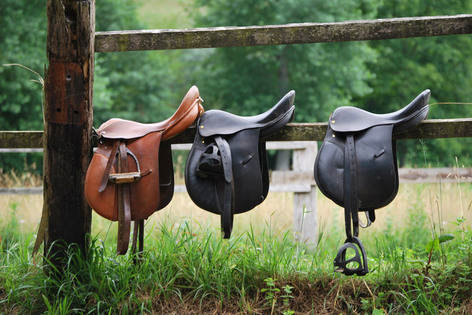
Jumping saddles are available in both leather and synthetic materials.
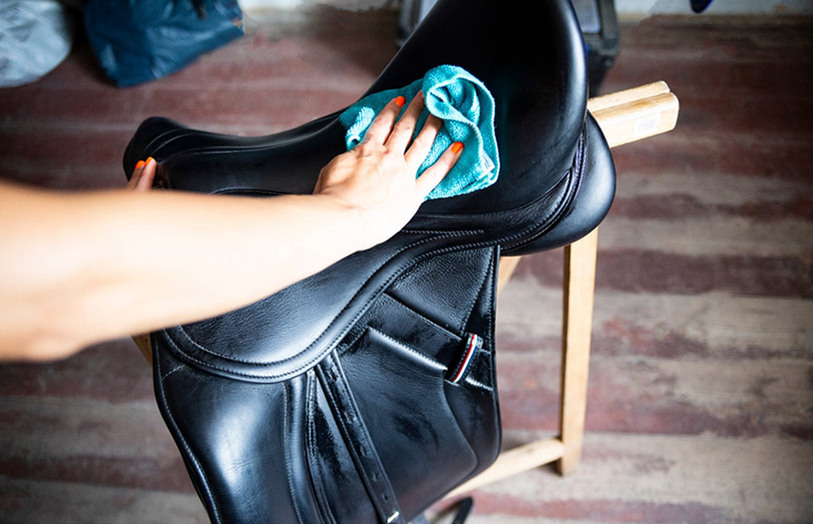
A good-quality leather saddle can last for many years when cared for properly, and there's a large second-hand market if you're looking to reduce the cost of buying one.
Synthetic saddles tend to be lighter and can be easier to maintain, which may appeal if you want something practical for everyday riding.
The material itself shouldn't take priority over fit. Whichever you choose, the saddle needs to be suitable for both horse and rider.
New or second-hand jumping saddle?
You don't necessarily need to buy new to find a suitable jumping saddle.
Buying second-hand can give you access to a wider range of brands and models at different price points. A well-maintained used saddle can offer good value, particularly if you know what you're looking for.
Before buying a second-hand jumping saddle, check:
- The overall condition
- Girth straps and stitching
- Panels and underside
- Signs of repairs or damage
- Manufacturer markings and serial numbers
- The stated seat size and any available fitting information
Ask the seller about the saddle's history and have it professionally checked and fitted before putting it into regular use.
Our guide to buying a second-hand saddle covers what to look for in more detail.
What size jumping saddle do I need?
It's tempting to focus on a single seat measurement or width, but saddle sizing is more complicated than that.
The right saddle needs to accommodate the rider while being suitable for the horse's back.
The same advertised size can also vary between different makes and models.
Rather than trying to determine the correct jumping saddle from an online size chart alone, use the advertised measurements to narrow down your options and work with a qualified saddle fitter to establish what is suitable for your horse.

Should you choose an adjustable jumping saddle?
Some jumping saddles have interchangeable gullets or other adjustable features.
This can provide useful fitting options, particularly as a horse changes shape, but an adjustable saddle isn't automatically suitable for every horse.
Changing the gullet is only one aspect of saddle fit. The tree shape, panels, balance and other features still need to work with your horse.
An adjustable saddle should therefore still be professionally fitted and regularly checked.
Try before you decide where possible
How a saddle looks on a stand doesn't tell you how it will feel once you're riding.
Where possible, try suitable saddles with the help of a qualified saddle fitter.
Pay attention to how the saddle feels while you're riding on the flat as well as over fences. Consider whether you feel balanced, whether your leg sits comfortably and whether you can move naturally into and out of your jumping position.
Your horse's movement and comfort need to be assessed too.
Jumping saddle buying checklist
Before choosing a saddle, consider:
- Does it fit your horse correctly?
- Does it suit the type and level of jumping you do?
- Does the seat allow you to remain balanced?
- Is the flap suitable for your leg length and position?
- Are the knee and thigh blocks comfortable rather than restrictive?
- Is the saddle in good condition?
- If buying second-hand, do you know its history?
- Has it been assessed by a qualified saddle fitter?
The best jumping saddle isn't necessarily the most expensive or the one with the most features. It's the one that works for your individual horse and allows you to ride comfortably and effectively.
Browse jumping saddles for sale
If you're ready to start looking, Horsemart has new and second-hand jumping and event saddles advertised by private sellers and equestrian businesses.
Browse jump and event saddles for sale on Horsemart or browse all saddles for sale.
Once you've found a potential saddle, arrange for it to be professionally assessed for your horse rather than relying on the advertised size alone.