From everyday hacking to dressage and showjumping, different types of horse saddles are designed to support different riding positions and disciplines.
Choosing the right saddle isn't simply a case of picking the one that looks best or matches the type of riding you do. It needs to work for both you and your horse, with the correct fit being essential for your horse's comfort and freedom of movement.
If you're looking for your next saddle, here's a guide to some of the most common types of horse saddles you'll come across and what they're designed for.
Looking for a saddle? Browse new and second-hand saddles for sale on Horsemart.
General purpose saddles
A general purpose saddle, often shortened to a GP saddle, is designed to accommodate a mixture of activities rather than specialising in one particular discipline.

You'll commonly see GP saddles used for:
- Hacking
- Flatwork
- Riding club activities
- Low-level jumping
- Everyday riding
The shape sits somewhere between a dressage and jumping saddle. The saddle flap is generally more forward-cut than a dressage saddle but straighter than you'd typically find on a dedicated jumping saddle.
This allows riders to shorten their stirrups for jumping while still being able to ride comfortably with a longer leg for flatwork.
Who is a GP saddle suitable for?
A GP saddle can be a good choice for riders who enjoy a variety of activities with their horse and don't need a highly specialised saddle.
For example, if you spend most of your time hacking, schooling and doing some jumping, a well-fitted GP saddle may offer the versatility you need without having separate saddles for different activities.
Browse GP saddles for sale on Horsemart.
Jumping saddles
Jumping saddles are designed to support the shorter stirrup length and more forward leg position used when jumping.

One of their most recognisable features is the forward-cut saddle flap, which provides space for the rider's knee when the stirrups are shortened.
Many jumping saddles also have knee and thigh blocks designed to offer additional support, although their size and position varies considerably between different makes and models.
Who is a jumping saddle suitable for?
A jumping saddle may be suitable if a significant proportion of your riding involves:
- Showjumping
- Cross-country
- Eventing
- Jump training
Riders who predominantly jump may find a specialist jumping saddle allows them to maintain their jumping position more comfortably than a GP saddle.
However, the amount of support and depth of seat can vary significantly between jumping saddles, so personal preference and rider fit matter too.
Browse jump and event saddles for sale on Horsemart.
Dressage saddles
Dressage saddles are designed around the longer leg position used for flatwork and dressage.

They usually have a straighter and longer saddle flap than GP or jumping saddles, allowing the rider's leg to sit more vertically underneath them.
You'll also commonly find a deeper seat and more substantial knee blocks, although the exact design varies between saddles.
Who is a dressage saddle suitable for?
Dressage saddles are primarily designed for riders focusing on:
- Dressage
- Flatwork
- Schooling
You don't necessarily need to compete in dressage to use one. Riders who primarily school on the flat may also prefer the position and support offered by a dressage saddle.
If you regularly combine flatwork with jumping, however, a GP saddle or separate jumping saddle may offer greater versatility.
Browse dressage saddles for sale on Horsemart.
VSD saddles
A VSD saddle can look similar to a GP saddle but generally has a slightly straighter-cut flap.

The term comes from the German Vielseitigkeitssattel Dressur, and you'll often see VSD saddles described as a dressage-biased version of a general purpose saddle.
They can offer a useful middle ground for riders who mainly hack and school but still want more versatility than they'd get from a dedicated dressage saddle.
Who is a VSD saddle suitable for?
A VSD may suit riders who spend much of their time:
- Hacking
- Schooling
- Doing flatwork
- Taking part in lower-level varied activities
They're particularly worth considering if you like the longer leg position of a dressage saddle but don't want something quite as specialised.
Browse VSD saddles for sale on Horsemart.
Showing saddles
Showing saddles are designed to create a neat appearance while allowing the judge a good view of the horse's shoulder and overall conformation.

They tend to have a straighter, more minimal cut than many everyday saddles and are often relatively close-contact in their design.
The exact saddle used can depend on the type of horse or pony and the showing class being entered.
Who is a showing saddle suitable for?
As the name suggests, these saddles are predominantly aimed at riders competing in showing classes.
For riders who also hack, school or jump regularly, a separate everyday saddle may be more practical.
Browse showing saddles for sale on Horsemart.
Working hunter saddles
Working hunter saddles need to balance presentation with practicality.
 David Dyer Working Hunter Saddle
Unlike some traditional showing classes, working hunter competitions include jumping, so the rider needs enough room to shorten their stirrups and adopt a secure jumping position.
As a result, working hunter saddles generally have a slightly more forward cut than a traditional showing saddle while retaining a smart, relatively unobtrusive appearance.
They're primarily designed for riders competing in working hunter classes rather than as an all-purpose everyday saddle.
Browse working hunter saddles for sale on Horsemart.
Pony saddles
Pony saddles aren't simply smaller versions of adult horse saddles.

They need to accommodate the pony's proportions while also fitting the rider correctly. This can become particularly important when matching small ponies with growing children.
As with any saddle, the label or seat size alone isn't enough to determine whether it will fit.
A qualified saddle fitter can assess the combination of pony, saddle and rider and advise on the most suitable option.
Browse pony saddles for sale on Horsemart.
Synthetic vs leather saddles
As well as choosing the style of saddle, you'll also come across a choice between traditional leather and synthetic materials.
Leather saddles
Leather remains a popular choice and, when cared for correctly, a good-quality leather saddle can last for many years.

Second-hand leather saddles are widely available, which can also make it possible to buy a higher-specification saddle for less than its original new price.
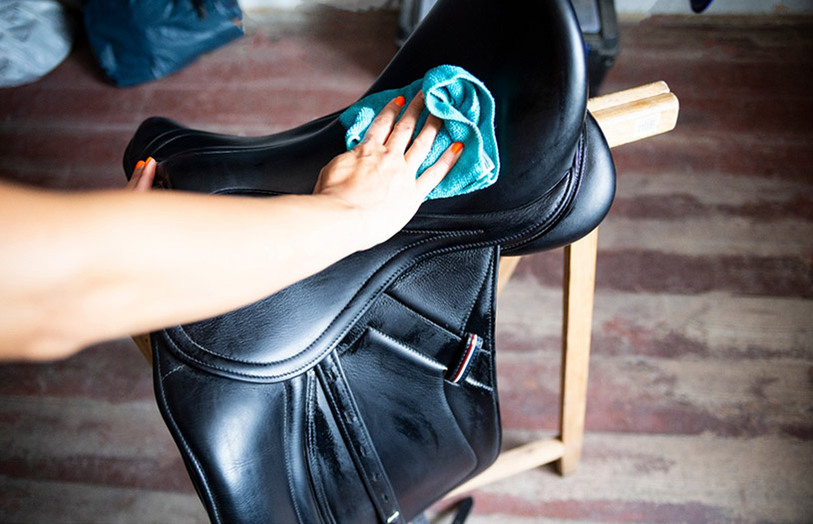
They do, however, require regular cleaning and conditioning to keep the leather in good condition.
Synthetic saddles
Synthetic saddles are generally lightweight and easy to maintain. Many can be cleaned simply without the conditioning required by leather, which can make them practical for everyday use.

There are now synthetic options available across a wide range of disciplines, so choosing between leather and synthetic often comes down to fit, budget, intended use and personal preference.
Which type of saddle should I choose?
Start by thinking about what you actually do with your horse most often.
If you hack, school and occasionally jump, a GP saddle could provide the versatility you need.
If jumping makes up a significant part of your riding, you may prefer the more forward-cut design of a jumping saddle.
If your focus is predominantly flatwork or dressage, a dressage saddle can accommodate the longer leg position associated with this type of riding.
And if you compete in a specialist discipline such as showing or working hunter, a saddle designed specifically for that purpose may be worth considering.
However, discipline is only one part of choosing a saddle.
Saddle fit comes first
Whichever type of saddle you choose, it needs to fit your horse and work for you as the rider.
Two saddles labelled as the same size and width can fit very differently depending on their tree, panels, shape and manufacturer. Horses can also change shape through changes in weight, fitness, age and muscle development.
This means you shouldn't choose a saddle based solely on its advertised measurements or because the same model fits another horse.
The British Horse Society recommends using a Society of Master Saddlers Qualified Saddle Fitter to assess saddle fit. A professional saddle fitter can consider your horse's conformation and movement alongside your own requirements as a rider.
This is particularly important when buying a second-hand saddle, as it will previously have been used and fitted to another horse.
Buying a second-hand saddle
Buying second-hand can give you access to a wide range of makes and models at different price points, and there are often good-quality saddles available for considerably less than their original new price.
Before buying, check the saddle carefully for wear or damage, ask about its history and don't assume that the stated size means it will fit your horse.
We've put together a full guide to buying a second-hand saddle, including what to look for in photographs, questions to ask the seller and what to check before paying.
Find the right saddle on Horsemart
Whether you're looking for a versatile GP, a specialist dressage or jumping saddle, or something for showing, you can browse new and second-hand saddles from private sellers and equestrian businesses on Horsemart.
Browse saddles for sale on Horsemart and find the latest saddles available across the UK.
Once you've found one you're interested in, remember that the advertised type, size and measurements are only a starting point. Have the saddle professionally assessed for your horse before putting it into regular use.