Are you an overthinker? Here’s how to stop the overthinking...
In this blog, I’d like to give you two tried and tested techniques to stop overthinking, the destructive ‘what-ifs’ that plague so many of us. Overthinking something can be stopped, but we need to put the handbrake on and override the automatic thoughts. We need to take control.
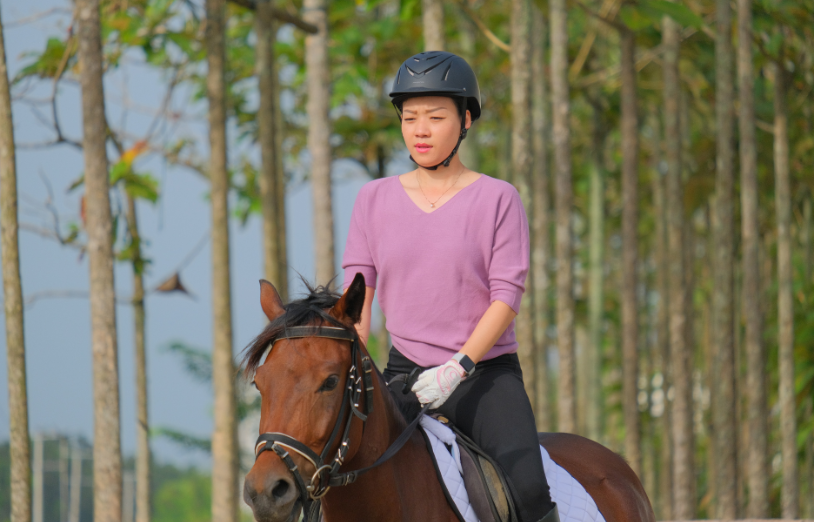
Having continuous negative commentaries or movies dominating our thoughts not only impacts our riding, but also causes mental and physical fatigue and embeds those harmful thoughts deeply into our unconscious minds. Did you know that those pictures and movies act as instructions for the mind? That’s why when we see a ‘what if’ unfolding in our mind’s eye off the horse, it makes us feel even worse when we’re on the horse, because our mind is aiming to re-create the ‘what if’!
Imagine being bombarded with all those panic-ridden pictures and dialogues every waking moment, no wonder the unconscious mind creates in us feelings of anxiety and overwhelm. Those feelings are there to keep us ultra-safe. They are messages from a very protective mind, the part of the mind that thinks only of survival.

If we interrupt the negative sights and sounds often enough and early enough in the process, the interruption becomes a habit and the full movie or over-analytical conversation becomes jammed. We can do this in several ways, I’m going to show you two ways to alter your words and feel very differently about them.
Start by trying out the techniques when you’re calm and centred, so that you know the method and can apply it when you feel yourself drift into overthinking.
Remember to practise often, as with most new habits, it takes a bit of time to install.
Stop the doubting, negative self-talk – using the sounds of the words.
-
Bring one of those real situations to mind, when you were overthinking. What were you saying to yourself, what were you thinking.
-
If you aren’t sure what you were saying to yourself, imagine a speech bubble coming out of your mouth in that picture. What would you have been saying in that moment?
-
So, that phrase you said to yourself, was XXXXXX.
-
Say that old phrase exactly as you used to do in that picture and notice the feelings present then.
-
Now say that phrase slowed down to about half normal speed and notice how the feelings change.
- Now say the phrase even slower, hear the words like in slow motion, drawn out. Notice how the feelings are changing for the better.
- Now slow the phrase down, so that you pause and take a breath between each word. Notice how the feelings change even more.
- Now double the length of the pauses between each word!
-
So when you try to think like you used to do, what do you notice that’s different now?
Stop the doubting, negative self-talk – using the way the words look.

-
Bring one of these real situations to mind where you were overthinking. What were you saying to yourself, what were you thinking?
-
If you aren’t sure what you were saying to yourself, imagine a speech bubble coming out of your mouth in that picture. What would you have been saying in that moment?
-
So, that phrase you said to yourself, was XXXXXX.
-
Picture that sentence in front of you, see the words. If this is hard, type them out.
-
Are the words in colour (which colours) or black and white? Are they in a certain font, capitals or lowercase letters? Are they underlined or highlighted?
-
Now read the sentence and notice the feelings that were present.
-
Stretch the words out, so the sentence has double the size of the spaces between the words. Now read the sentence, what do you notice in how your feelings change?
-
Now really stretch that sentence, so that the spaces are massive between the words, so that it’s not easy to read, you struggle to put the letters into words. Read the sentence and notice how the feelings are changing for the better.
-
Stretch the sentence so that the spaces are huge!
-
And stretch each word so that the letters a r ef a r a p a r t t o o! Stretch them even more! You’re having to piece each word together letter by letter and it takes a lot of effort now.
-
Notice how much better you feel now. So when you try to think like you used to do, what do you notice that’s different now.
You can adapt these methods to change the colour or font of the words, you can also change the voice that says them. Small changes like this disrupt the pattern just enough to help you to stop, step back and see things differently.